
Fayette County Criminal Court Cases
Fayette County criminal court cases begin at the court level set by Kentucky law. Fayette District Court hears misdemeanors, traffic matters, violations, and early steps in felony prosecutions, including preliminary hearings. After a grand jury returns an indictment, or an information is filed where authorized, a felony proceeds in Fayette Circuit Court. Lexington has no separate municipal court. A search for a Lexington ordinance or misdemeanor case therefore belongs at the Fayette District Criminal/Traffic Division, not at a city court portal.
The elected Fayette Circuit Court Clerk maintains the files for both court levels. The Kentucky Court of Justice Fayette page identifies the correct courthouse and clerk channels. Each file follows one prosecution. It may show the filed charges, event history, counsel, judge, bond entries, disposition, and sentence. It does not replace the police report or prove that the officer's first charge remained unchanged.
The official Fayette courts page provides a clear view of the local court structure.
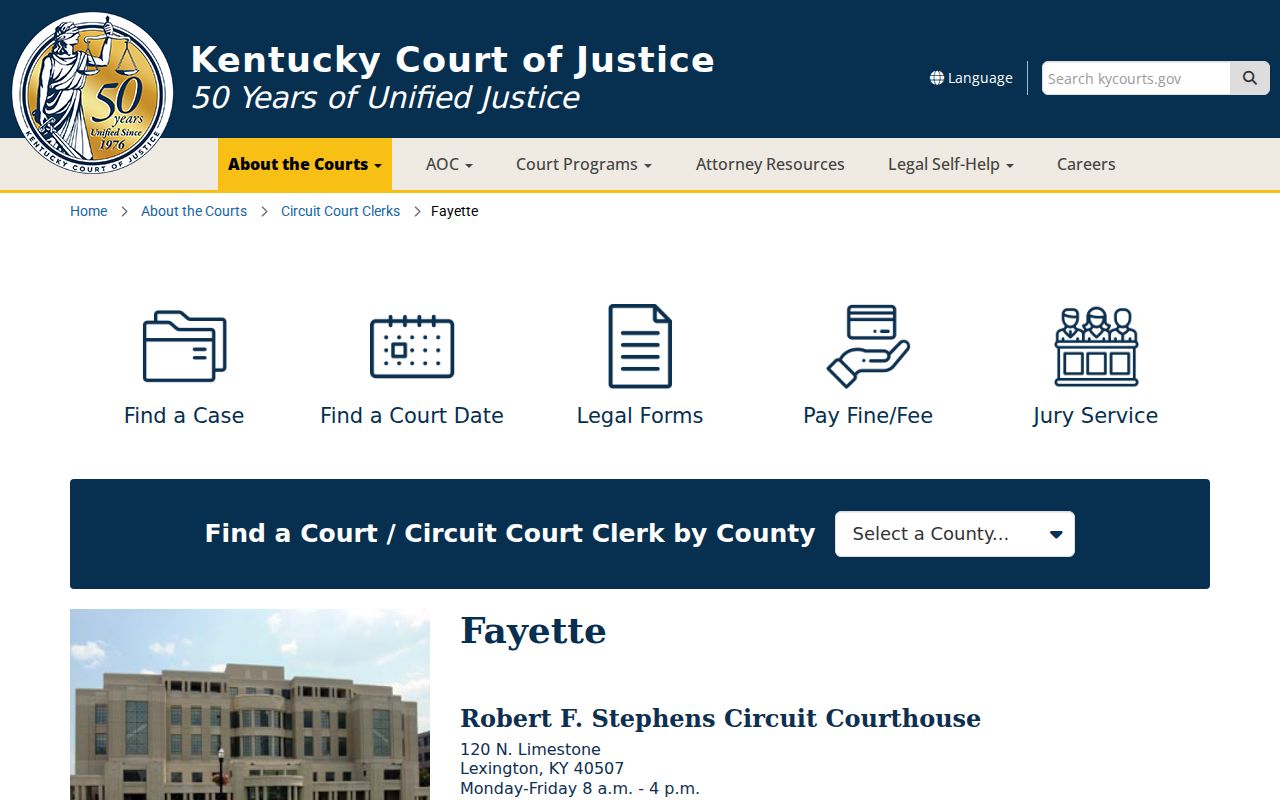
That structure matters because the right clerk division depends on both the charge level and the current stage of the case.
Fayette County Criminal Court Divisions
Three clerk counters answer different court-record needs in downtown Lexington. Choosing among them prevents a request for a felony judgment from landing at the misdemeanor counter or an appeal request from going to the trial division.
| Office | Criminal case role | Contact |
|---|---|---|
| Circuit Criminal | Felony indictments and information cases; case money and bail-bond processing | 120 N. Limestone, Suite C-103 859-246-2224 Weekdays, 8 a.m. to 4 p.m. |
| Circuit Appeals/Records | Appeals, video proceedings, public review space, research terminals, and copiers | 120 N. Limestone, Suite C-33 859-246-2147 Weekdays, 8 a.m. to 4 p.m. |
| District Criminal/Traffic | Misdemeanors, traffic, violations, preliminary felony work, warrants, and bonds | 150 N. Limestone, first floor 859-246-2228 Open 24/7 except Dec. 24 and 25 |
The Fayette Circuit Criminal Division page shows where indicted felony files and related financial entries are handled.
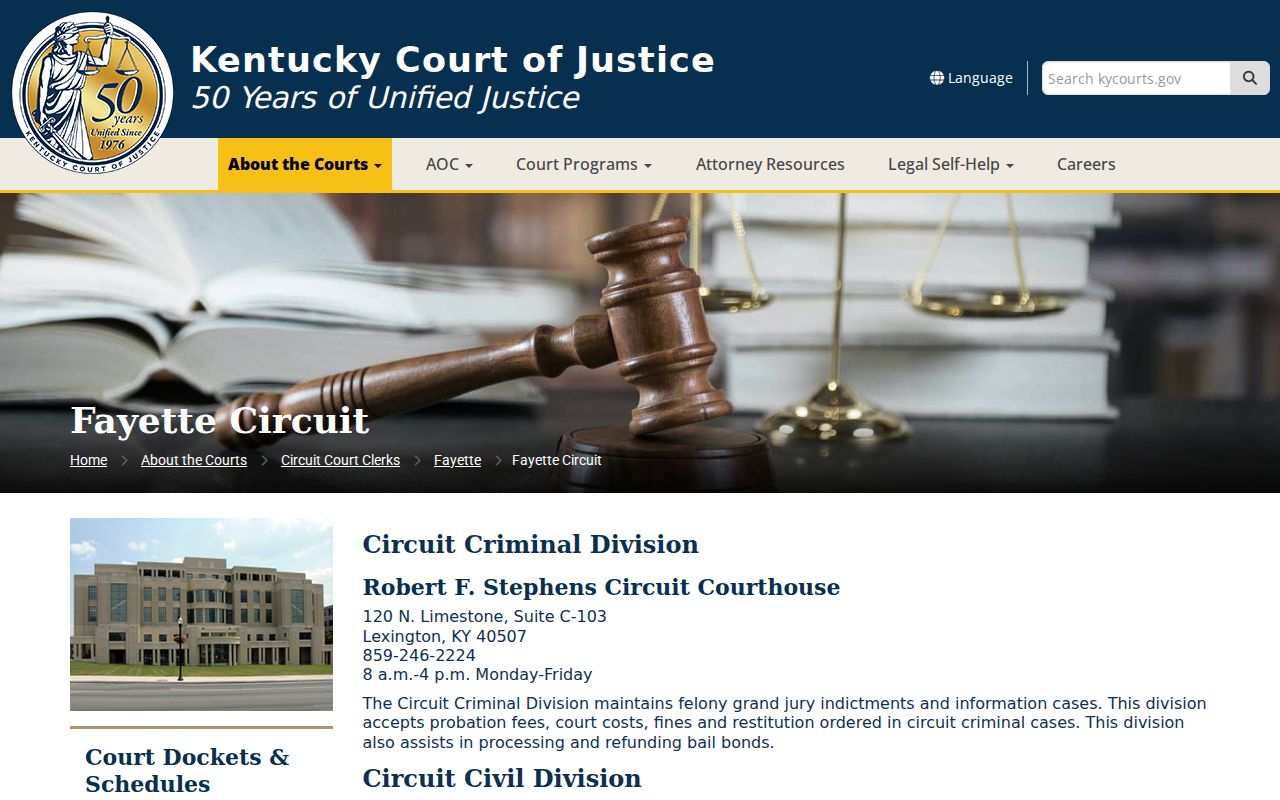
For a public file review, ask the clerk whether the docket and desired document are available at the counter, terminal, or archive.
Searching Fayette County Case Records
Start with KYeCourts Public Court Records guest access for a free index. Then use the Fayette clerk for the official case documents. CourtNet holds public case information from all 120 Kentucky counties, but the official CourtNet contact page describes a restricted media subscription. It is not a general-public signup page. The courthouse terminal and clerk counter remain dependable paths when guest results are incomplete.
- Open guest access and select Fayette County. Use the criminal or traffic case category that fits the matter.
- Search by case number when known. A party-name search is useful, but common names need another matching fact.
- Narrow results by court level, case type, and filing year. Date-of-birth access may be restricted or vary by interface.
- Open the docket and read the entries for each charge. Check the judgment rather than relying on the result caption.
- Ask the correct Fayette clerk division to inspect or copy the official document. Specify whether a plain or certified copy is needed.
The common retrieval fields below apply to clerk and public-terminal work. Controls may vary across authorized CourtNet interfaces.
| Field Label | Type | Required | Notes |
|---|---|---|---|
| Case Number | Text | One search path | Best exact key; often encodes year, type, and sequence |
| Last and First Name | Text | Name search path | Use the legal surname and confirm a common name |
| County | Dropdown | Yes statewide | Select Fayette |
| Court Level and Case Type | Filter | No | Choose Circuit or District and the relevant category |
| Filing or Year Range | Filter | No | Helps narrow common-name results |
AOC FastCheck is another statewide channel, but its compiled report is marked “Not an Official Court Record.” One-time results arrive by U.S. mail, while registered-user results are kept online for 30 days. The AOC Records Unit is available at 800-928-6381 on weekdays from 8 a.m. to 4 p.m. ET. Use the clerk when the actual Fayette County pleading, order, judgment, or certified copy is needed.
Archived Fayette County Criminal Case Files
An older Fayette County criminal case may have left the courthouse without becoming searchable by name at the archive. Records about 15 to 35 years old may be at the State Records Center. That center requires both a case number and a locator number; it cannot search by name or Social Security number alone. Ask the Fayette clerk for those two keys first. Then contact the State Records Center at state.records@ky.gov or 502-564-1710.
Files 36 years old or more may be held by the Kentucky Department for Libraries and Archives. Its reference desk uses kdla-referencedesk@ky.gov and 502-564-1770. Retention schedules can authorize destruction, so age does not guarantee that a paper file still exists. The clerk must confirm survival and location. The statewide court-record request instructions explain why the clerk is the starting point for the case and its retention trail.
The official request page illustrates the fallback when an online Fayette criminal case search does not supply the needed document.
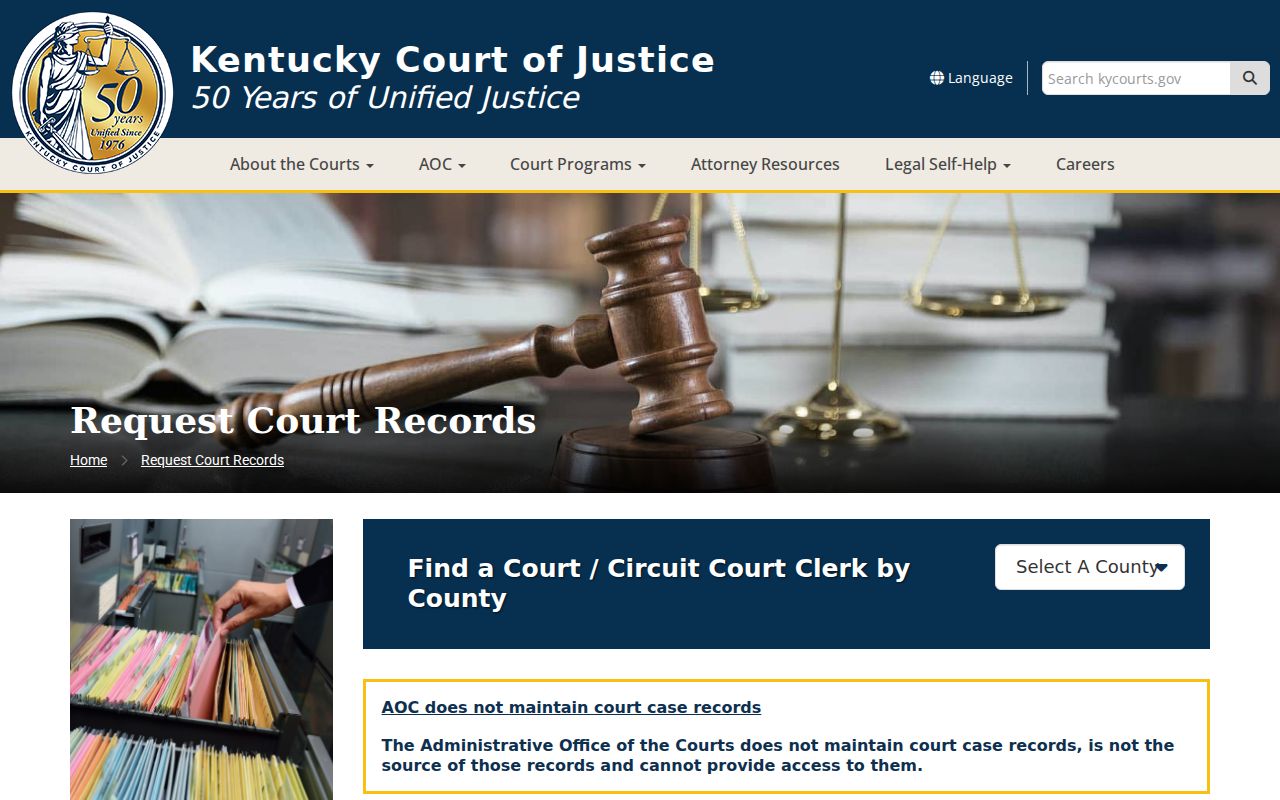
A focused request should identify the case, court level, document, year, and whether an ordinary or certified copy is required.
Inside a Fayette County Case File
A Fayette County criminal case file is organized around one prosecution, not around a person's full history. The caption and docket identify the proceeding. Charging papers show what the prosecutor filed, while later entries show how each count changed. Hearing notices, motions, orders, pleas, trial events, judgments, and sentence terms supply context that a result screen may omit. The file can also show bond activity and public financial entries such as costs or restitution.
| Case Number & Court | Fayette division, filing year, case type, sequence, and status |
|---|---|
| Charging Document | Complaint, citation, indictment, or information and the filed counts |
| Docket Entries | Arraignment, motions, hearings, plea, orders, trial, and warrant events |
| Hearing Dates | Scheduled event type, courtroom, judge, date, and time where public |
| Disposition & Judgment | Outcome for each count, including conviction, dismissal, amendment, or acquittal |
| Sentence & Conditions | Confinement, probation orders, costs, restitution, and other public terms |
Some fields are restricted. Juvenile information, sealed or expunged content, victim details, protected addresses, and sensitive identifiers are not ordinary public case fields. Document availability also varies by record, age, and access channel.
Reading Fayette County Criminal Case Outcomes
Read every count, not just the case caption. The arresting officer's first charge can differ from the charge later filed by the prosecutor. A count may then be amended, dismissed, resolved by plea, tried, or left pending. One case can contain several counts with different results. A dismissed charge is not a conviction, and “pending” merely means that no final outcome is shown yet.
- Disposition
- The recorded outcome of a charge or the case.
- Nolle prosequi
- A prosecutor's formal choice not to proceed with a charge, subject to Kentucky procedure.
- Acquittal
- A not-guilty determination after the matter is decided.
- Indictment
- A formal felony charge returned by a grand jury.
- Sentence
- The punishment and conditions imposed after a conviction.
A plea agreement is a proposed negotiated resolution that remains subject to court acceptance. The judgment and sentence are stronger sources for the final result than a search-result label. If the docket lacks a matching disposition, ask the clerk whether a later order exists or whether reporting is still in progress.
How a Criminal Case Moves
Fayette County felony work may start in District Court with a complaint, initial appearance, and preliminary hearing or waiver. Grand-jury action can then create a Circuit Court indictment. Circuit arraignment addresses the filed charge and plea. Discovery, motions, conferences, and hearings follow before a negotiated plea or trial. The court then enters judgment and sentence, with an appeal or later motion possible.
Case flow: Charges Filed → Arraignment → Pretrial → Plea or Trial → Disposition → Sentencing
The Fayette District Criminal/Traffic Division is the practical counter for misdemeanor cases and early felony proceedings.
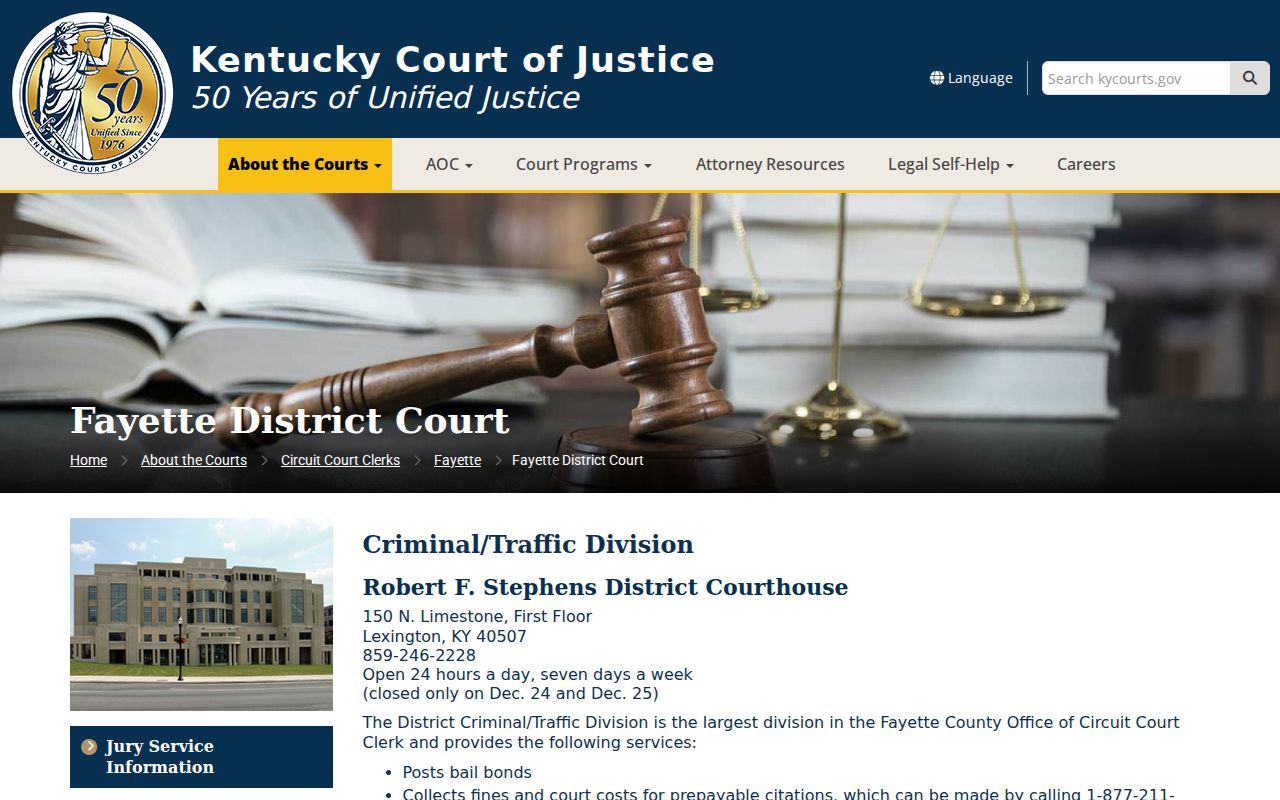
Following the file from District to Circuit Court is vital because an indicted felony continues on the Circuit docket after its early District Court steps.
Federal Criminal Cases Outside Fayette County
Fayette County lies in the U.S. District Court for the Eastern District of Kentucky, but federal criminal dockets do not appear in Fayette CourtNet. Search them through PACER, which requires registration and applies the current federal fee schedule. The federal district clerk can address access to filed documents and archived federal files. This route is separate from both Fayette clerk records and Kentucky criminal-history products.
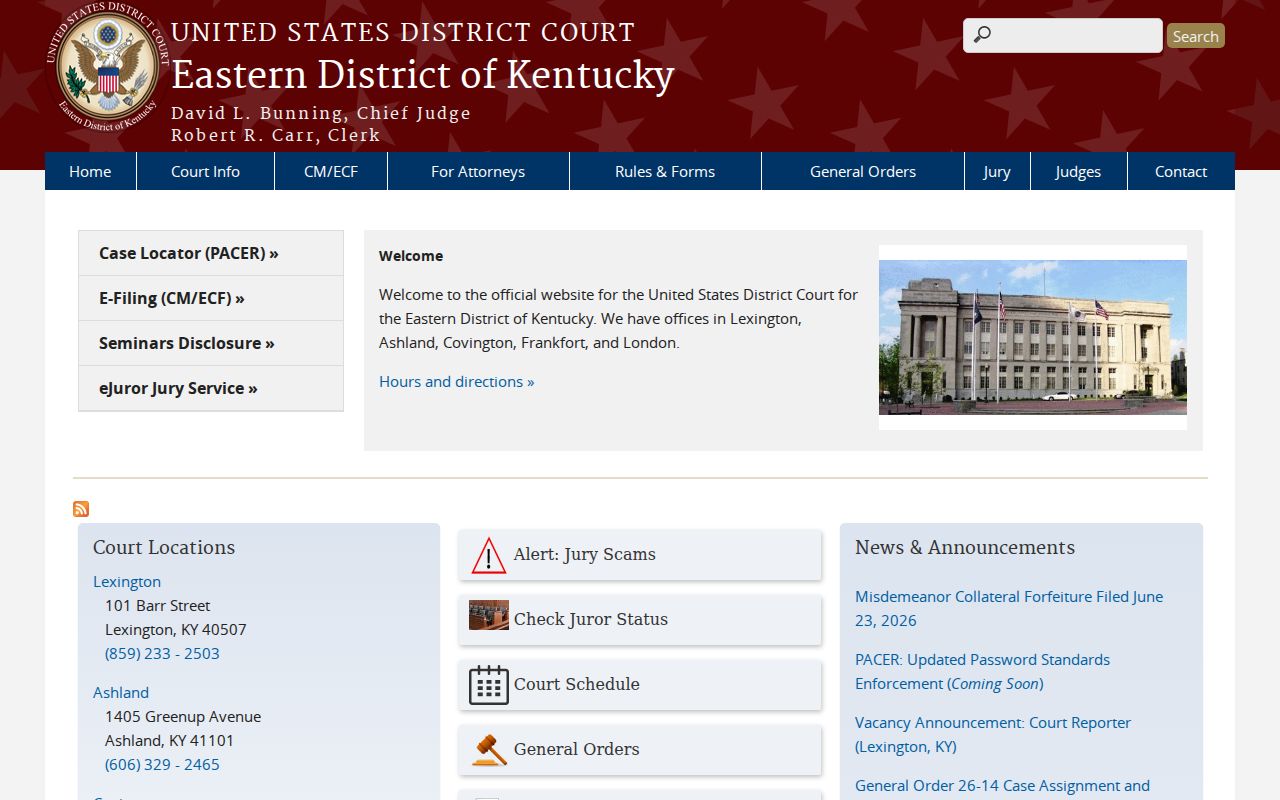
The Eastern District of Kentucky website shows the federal courthouse layer that sits outside Fayette County criminal court case systems.
An FBI Identity History Summary is also different. It is a subject-only nationwide self-review product, not a federal docket search. Likewise, the Bureau of Prisons locator concerns federal custody, not a Fayette prosecution or Kentucky prison case.
Case Record Access & Restrictions
Kentucky public-record law does not make every case detail open. The Kentucky Open Records Act, KRS 61.870 through 61.884, governs access to nonexempt agency records and supplies a request framework. Court access also turns on judicial rules, sealing orders, retention, and the kind of document sought. Juvenile cases are confidential and do not function like ordinary adult CourtNet records. Grand-jury deliberations and sealed warrants remain restricted.
Victim information, protected addresses, personal identifiers, and other sensitive content may be withheld or redacted. An online index may show less than the available courthouse file, but public status does not erase every privacy limit. When requesting a record, identify the case number, court, year, and specific document rather than asking the clerk to research an open-ended question.
Expunged Fayette County Criminal Court Cases
A dismissal does not always vanish at once. Kentucky's result depends on the exact disposition, whether a dismissal was with prejudice, the statutory interval, and the route that applies. Some acquittals and dismissals with prejudice receive automatic expungement after the required interval unless the person objects. Other matters may require an AOC eligibility certification and a petition in the Fayette court that handled the case.
Begin with the final disposition in the Fayette clerk's file. Use the current Kentucky Court of Justice expungement materials and forms to identify the right path. Petition-based relief under KRS 431.073 is limited to eligible matters, including only specified Class D felonies. Do not infer eligibility from a short charge label. After an order, allow source agencies time to process it and then recheck the clerk record.
Note: An expunged file should leave routine public access, though courts and specifically authorized agencies may retain statutory access.