
Checking Criminal History in Lexington
Start with the Lexington record type needed, not a broad name search. Lexington Police keeps incident and arrest narratives. Community Corrections holds local booking and custody data. The Fayette Office of Circuit Court Clerk maintains District and Circuit cases. A statewide court-history report and a KSP self-review serve wider but different purposes. This order keeps a police allegation from being mistaken for a conviction and keeps a Lexington detention search from being used as a full criminal history.
- Search the KYeCourts public guest index for a quick case lead, then use the Fayette clerk for official Lexington case documents.
- Request a Lexington Police report by incident number, date, place, or involved party when the police narrative is the goal.
- Check Community Corrections online or by phone for a recent Lexington booking, current charge, bond, or custody status.
- Match a misdemeanor or early felony event to Fayette District Court. Move to Circuit Criminal after an indictment or information.
- Use AOC FastCheck for compiled statewide court data or the KSP subject-only route to review your own centralized Kentucky history.
Common names need a second identifier. A case number, report number, booking number, year, or court level can separate Lexington records that look alike. If a result is incomplete, ask the source office for the underlying Lexington file rather than assuming the screen is the full record.
One Lexington Records System
Lexington and Fayette County are coterminous under Kentucky's only urban-county government. Voters approved the merger in 1972, and it took effect on January 1, 1974. That history explains why a city department can perform a countywide role. Lexington Police serves urban, suburban, and rural Fayette, while LFUCG Community Corrections runs the local detention center. There is no second incorporated Fayette city that needs its own police and court guide.
The merged structure saves one type of confusion but creates another. “City record” does not mean one city database. A Lexington police report, Lexington detention booking, District Court docket, and KSP history remain separate files. Each office controls its own Lexington source record, access rules, and corrections. The official Lexington-Fayette Urban County Government directory is the practical route to Lexington departments, but it does not combine those records into one search.
Note: Georgetown, Nicholasville, and Versailles are outside Fayette County and do not belong in a Lexington criminal records search.
Lexington Police Department Records
Lexington Police creates incident reports, arrest reports, crash reports, and related investigative records. Central Records and the Open Records Unit handle Lexington public requests. The department does not perform background checks. It directs court-history questions to AOC, while authorized fingerprint workflows use the appropriate state route. A Lexington police report remains the best source for the officer's account, alleged conduct, event location, and evidence references, subject to legal redaction.
A useful Lexington request identifies the report or incident number when known, date or range, location, involved party, and desired medium. The Lexington request may also call for the requester's name, address, daytime phone, email, residency statement, and proof of authority for protected material. Submission routes include the electronic process, written request or email, mail, fax, and the counter. Broad demands for every Lexington record tied to a name are harder to retrieve and may sweep in protected material.
Lexington Police Open Records
Central Records is at Police Headquarters, 150 E. Main St., Lexington, KY 40507. The published records phone is 859-258-3675, and counter hours are Monday through Friday, 8 a.m. to 5 p.m. Current instructions permit email at ORR@lexingtonky.gov and fax at 859-425-2270. Published charges include $0.10 per page, $1 per CD, and $5 for a collision report through Open Records, plus lawful postage or processing.
The official Central Records location page shows the department's building and service details.
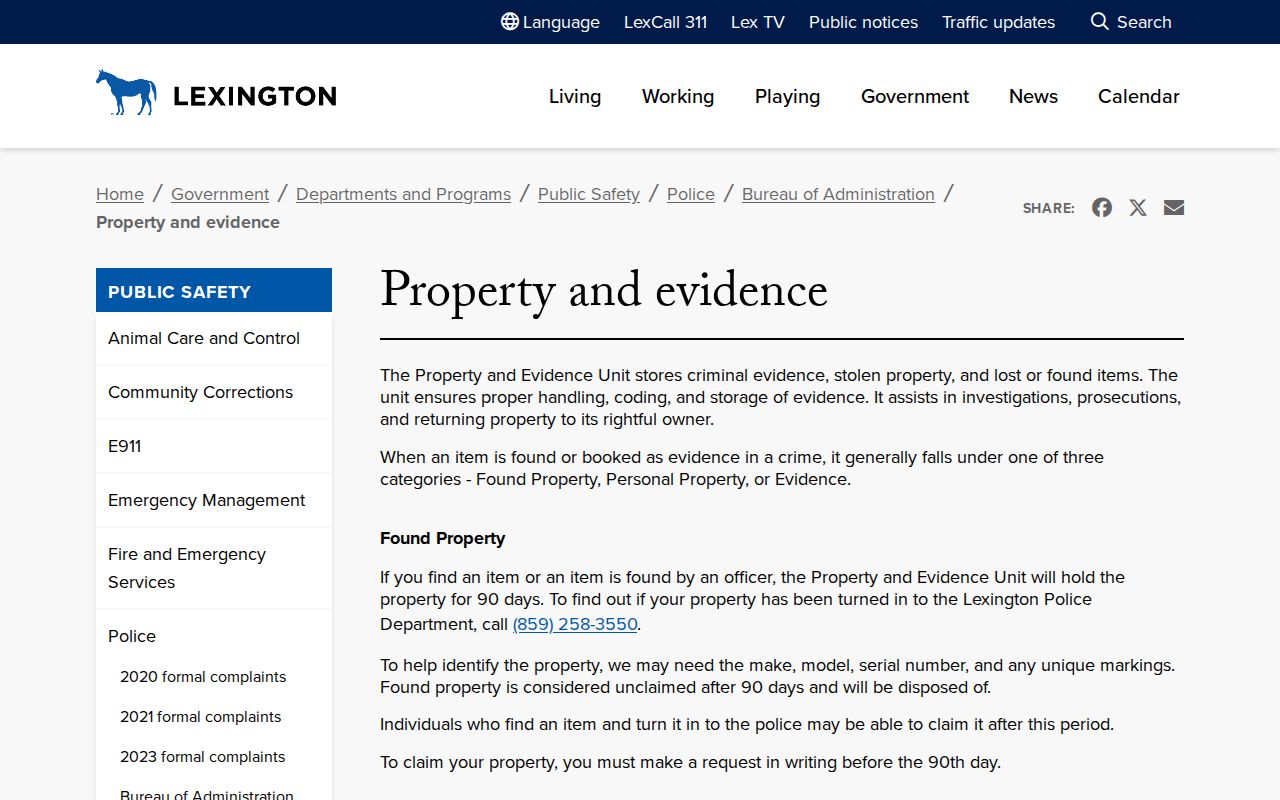
The pictured source confirms the physical counter that supports Lexington police record access when an online request is not enough.
Lexington Police Central Records
150 E. Main St.
Lexington, KY 40507
859-258-3675
Monday-Friday, 8 a.m.-5 p.m.
ORR@lexingtonky.gov
Fax: 859-425-2270
The Lexington agency uses a five-business-day response framework. Active investigations, juvenile information, victim details, personal identifiers, and Lexington records covered by another statute or court order may be withheld or redacted. A denial should identify its legal basis.
Reading Lexington Crime Data
Lexington Police reported 8,944 Part I offenses for 2024, including 12 arsons. That total was 13.8% below the 2023 count of 10,372. The 2024 components were 22 murders, 168 forcible rapes, 269 robberies, 422 aggravated assaults, 884 breaking and entering offenses, 6,191 larceny-thefts, and 976 auto thefts. These figures describe police-reported events. They are not conviction counts and do not predict the outcome of any one case.
The Lexington Police crime-data hub provides the official transparency context.
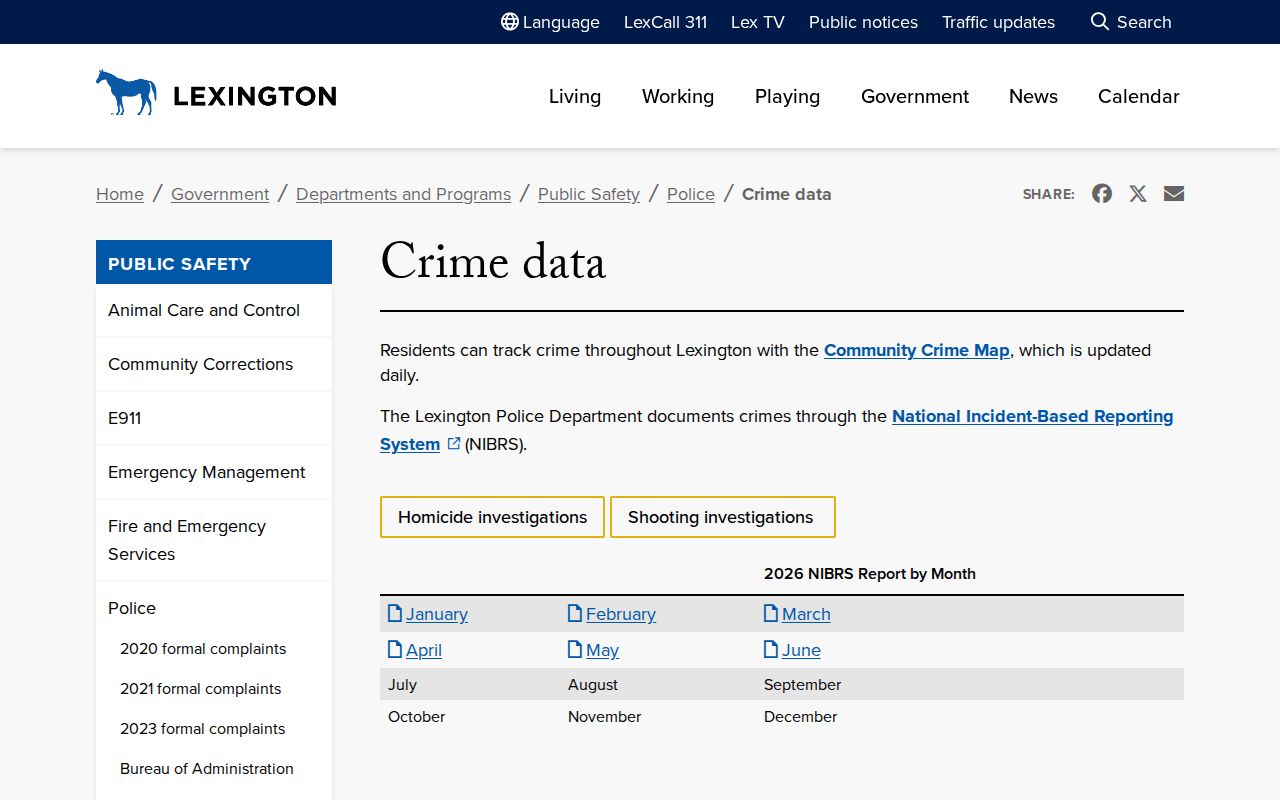
The Lexington data page helps a reader place Lexington police records in context without treating an offense count as an arrest, charge, or judgment.
LPD also reported 441,160 total police calls in 2024, with 244,359 dispatched calls, 64,964 officer-initiated calls, and 6,302 off-duty responses. Call totals and crime counts measure different activity. Neither set replaces the incident report or court file needed to understand a specific Lexington event.
Lexington Mental-Health Call Records
Lexington launched a Community Crisis Co-Response Team in September 2024. The program pairs a full-time mental-health professional with specially trained Lexington police officers. Official city material said Lexington police receive about 3,000 mental-health calls per year, and a federal grant through Kentucky Medicaid funded the first three years. The change affects how some calls are handled, but it does not turn every crisis response into an arrest or criminal case.
A co-response can create dispatch, CAD, incident, or body-camera material even when no one is booked. Those Lexington records require a focused Lexington Police open-records request and may need review or redaction. A requester should identify the date, location, call type, and known incident number. Community Corrections and the Fayette clerk become relevant only if the Lexington event leads to custody or a filed charge.
Lexington Arrests and Bookings
Lexington does not operate a separate city holding facility. A Lexington custodial arrest made by Lexington Police moves to the Lexington-Fayette County Detention Center at 600 Old Frankfort Circle. The LFUCG Division of Community Corrections creates the Lexington booking, charge and bond, property, custody, and release records. The detention information line is 859-425-2700, and a shift commander can answer current custody questions after regular public-facing office hours.
Use the Community Corrections inmate information route for recent Lexington custody. Ask for a specifically described booking record through the electronic or in-person open-record channel when a current Lexington lookup no longer shows the event. A roster entry proves a custody episode, not guilt. The court disposition controls the outcome of each filed charge.
From Lexington Arrest to Detention
After a Lexington custodial arrest, detention staff record identity, property, charge or hold paperwork, a photograph, and fingerprints as required. Staff also assess medical, mental-health, safety, and custody needs. Those classification details are not ordinary Lexington public roster data. Lexington public information can include a booking identifier, intake time, current status, initial charge, bond or hold, arresting agency, court link, and release status when available.
The next step is judicial review. Fayette District Court addresses the first docket, release conditions, misdemeanors, traffic matters, and early felony proceedings. A person may be released, remain detained, or later enter state custody after sentence. Kentucky Online Offender Lookup applies to Kentucky DOC incarceration or felony supervision, not the original Lexington jail intake. The lookup source changes as the case moves.
Note: A Lexington booking record should not disclose a housing pod, medical status, protective-custody flag, or other security-sensitive classification detail.
Municipal Court Records in Lexington
Lexington has no municipal court. Kentucky routes city ordinance, traffic, misdemeanor, and preliminary felony activity through Fayette District Court. Indicted felonies move to Fayette Circuit Court. A search for a “Lexington Municipal Court” portal will therefore miss the correct Lexington record holders. The Fayette Office of Circuit Court Clerk maintains both District and Circuit Lexington files.
| Municipal court | No separate Lexington municipal court exists. |
|---|---|
| District channel | Fayette District Criminal/Traffic handles misdemeanors, traffic, violations, and early felony proceedings. |
| Circuit channel | Fayette Circuit Criminal maintains felony indictments and information cases. |
| Lookup keys | Use a case number or party name, then select Fayette, court level, case type, and year range. |
| Public contents | May include charges, docket events, hearings, plea, judgment, sentence, bond, and financial entries. |
| Older files | Ask the clerk for the case and archive locator numbers before contacting the archive. |
The Lexington records are case-centered. They do not always contain the full police narrative or every unrelated statewide event. Read each Lexington count's disposition because “pending” is not an outcome, a dismissal is not a conviction, and a filed charge may differ from the booking allegation.
Lexington's 24-Hour Criminal Counter
Fayette District Criminal/Traffic is at 150 N. Limestone, Lexington, KY 40507, phone 859-246-2228. Kentucky Court of Justice lists the division as open 24 hours a day, seven days a week, except December 24 and 25. It is the practical counter for Lexington misdemeanor, traffic, violation, warrant and bond, and preliminary felony records.
The official Fayette District Court page confirms the division and contact route. Public courthouse terminals and the clerk are dependable Lexington fallbacks when an online index lacks enough detail. For a Lexington felony indictment, continue next door to Circuit Criminal at 120 N. Limestone, Suite C-103, 859-246-2224, weekdays from 8 a.m. to 4 p.m.
Where Lexington Records Go
Lexington records follow the event. Police create the incident or arrest report. Community Corrections adds a booking file if the person enters local custody. The Fayette clerk opens the District docket and, after indictment or information, the Circuit file. Qualifying fingerprints and dispositions can feed Kentucky State Police systems. Each transfer adds a new source rather than replacing the earlier one.
Record flow: Lexington Police › Community Corrections › Fayette District Court › Fayette Circuit Court after indictment › Kentucky State Police
Recent activity is most likely to appear first with police or detention staff. The filed charge and final outcome live with the court. A KSP self-review is identity-centered and statewide, while AOC FastCheck compiles court data and states that it is not an official court record. For countywide depth beyond Lexington, use the Fayette County criminal history overview.
Lexington Charges Split by Court
The court level also determines the prosecutor. The Fayette County Attorney prosecutes District Court criminal and traffic matters. The Fayette Commonwealth's Attorney prosecutes felony matters in Circuit Court. Neither office replaces the clerk as record custodian. Their role is charging and prosecution, while the clerk maintains the public case file.
The official Fayette County Attorney site represents the District Court prosecution layer.

The source helps distinguish the prosecutor's office from the Lexington police, detention, and clerk channels that actually hold the requested records.
A complaint or citation can begin in District Court. A felony then may go through a preliminary hearing or waiver, grand-jury review, and indictment before Circuit arraignment. The initial police charge can be amended, refused, dismissed, or superseded during that path. The Fayette County criminal court case page gives the county-level case file detail without turning the Lexington page into a repeat of it.
Public Access Rules in Lexington
Lexington Police and LFUCG records are subject to the Kentucky Open Records Act, while court documents begin with the Fayette clerk. A request should identify a record, date, event, and number. The law does not require an office to answer a broad research question as if it were a combined database. Active investigations, juvenile records, victim information, personal identifiers, sealed matters, and other protected material may be withheld or redacted under the controlling law.
Key Kentucky access laws:
KRS 61.870-61.884 creates the public-agency request and response framework.
KRS 61.878 lists exemptions that can support withholding or redaction.
KRS 17.150 governs access to specified law-enforcement records and permits limits during defined active work.
Ask for the reason when material is denied. A lawful redaction does not mean the entire Lexington record is closed. Public access also does not permit harassment, witness intimidation, or the spread of independently protected information. Verify important details with the office that created the source file.